White Bike
What it means

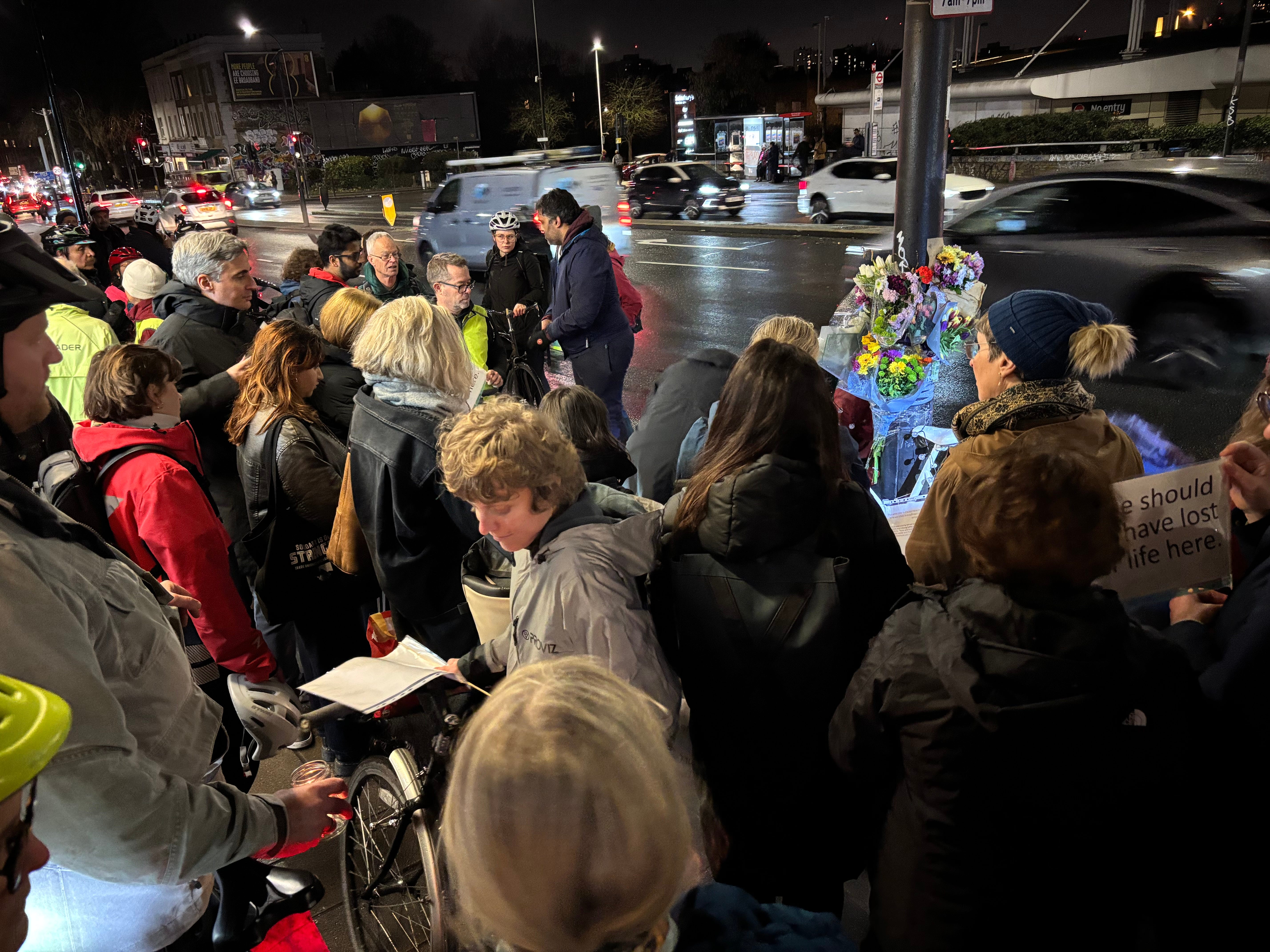
Last night’s Friday rush hour was just beginning to ease. As the main road began to open up again, traffic started to thunder in both directions as drivers hurriedly made their way home, perhaps running late. Delivery vans with a few final packages to drop off, loaded trucks setting off for a night crossing to Europe, Uber drivers clocking on for an evening shift and blue light convoys of prison transports for Belmarsh, unmarked police cars and ambulances heading at speed to Lewisham hospital. New Cross, glistening in the constantly falling drizzle, was nothing but bus engines grinding up the slight rise to the old Deptford Town Hall, and wet tyres roaring down the hill in the opposite direction.
We gathered on the pavement.
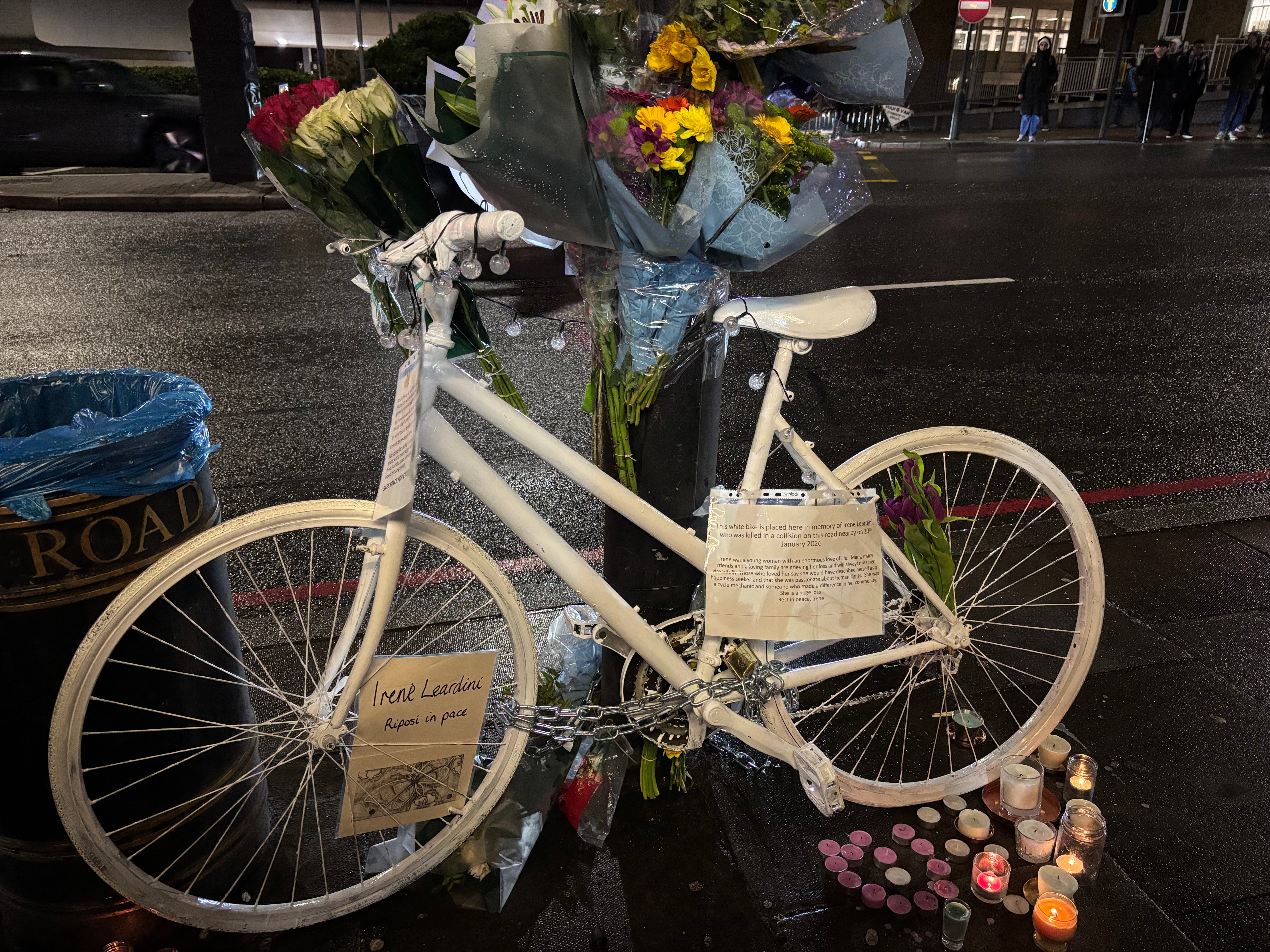
A few weeks ago, London recorded the first cyclist fatality of the year. On January 20th, a rider called Irene Leardini was killed on the New Cross Road. She was, according to friends and family, a very experienced cyclist, and a trained bike mechanic. Last night Lewisham Cyclists, with the blessing of Irene’s family, arranged a vigil for her memory. They placed a White Bike at yet another roadside. Some people brought candles, others flowers. There were a few speeches, some held signs aloft that declared “Cycling is not dangerous. This road is!”, we chatted for a short time among ourselves, and then we dispersed into the gathering night.
The White Bike will remain there, now.
London has seen considerable improvements over the last decade or so. Some of the infrastructure which has been designed, separating bikes from the motor traffic is genuinely fantastic. But this particular stretch of the A2 is one of many arterial roads managed by TfL rather than the individual boroughs, on which no material changes to protect vulnerable road users have been effected. There are advance stop boxes at junctions, but no clear path to access them for riders. And once the lights change, you’re on your own. It is almost as if the complexities and costs of doing the right thing to protect those who choose to ride are so overwhelming that the default position is simply to do nothing.
This is not an attitude that can be allowed to stand. It is not good enough; not in a city that has made genuine progress in other areas, in which the younger generations are rightly waking up to the benefits (and dare I say) pleasures of riding bikes versus taking the bus or tube. Failing so routinely and lazily to address the concerns raised by pressure groups calling for safe designs is a dereliction of duty. It deserts those who are minded to adopt cycling as a part of their lives; a one-stop measure which addresses in one stroke some of the biggest, and most intractable problems we face, from the cost of living, to health, pollution and climate change. Those of us who persist with our devotion to cycling in the city do so now in the face of public hostility, media goading and dangerous aggression from other road users. And yet each new rider added to London’s streets frees up space for cars and for public transport users on a system that is creaking at capacity. We know very well how vulnerable we are. We know what a potent solution the bicycle can be. We demand to be heard.
But over and above this campaigning voice, a thought settled with me overnight as I reflected on our brief and sad gathering in Irene’s name. And it is this: cycling forges bonds within society that are unmatched elsewhere. That is why we answered the call last night, and felt the need to stand together in the noisy dark and the damp.
The act of riding a bike is a quotidian miracle. I contend that, for 99% of the population, the moment that they first rode unsupported as a child, is a communal memory shared by almost everyone. That sudden rush of realisation that the guiding adult hand that had held you aloft was no longer there, and that you were turning the pedals alone is a staging post of childhood development that should take its place alongside other landmark steps along the way to independence. Though this joy often gets buried by modern life, by the acquisition of a car, by drifting away into adulthood with all its distractions and diversions, for many of us it never left. And even for those, like me, who only rediscovered the bicycle much later in life, it was imprinted on me, and could be reactivated like flicking a switch.
I use the word miracle advisedly. There is, even to this day, a niche but still very much alive discourse about the physics of riding: the fact that a bike stays upright at all is not as straightforwardly explicable as it might at first seem, and there are competing theories. I love the fact that it is not entirely understood, despite being with us for almost 200 years.
Something of that miracle rides with us, in our souls, every time we mount a bike and set off, to work, to the shops, to the pub, to a vigil for a killed rider. We marvel at the distance covered by our own means. We celebrate the lightness of touch that a bicycle lends to our streets, its quiet, its grace. We, uniquely, understand the fragility and beauty of this old-fashioned, forever relevant invention; a machine that propels us along a road with a turn of the pedal, transforming human locomotion, at the cost of nothing more than a little effort. We feel the air, we sense each contour of the road, each spot of rain. And we feel each other’s presence by our side, ahead of us. We like nothing more than to be surrounded by our kin, riding together. Imagine saying the same of car drivers (we are all car drivers too, or almost all) or pedestrians (we are all pedestrians too, or almost all). Cycling is different.
It is appalling that Irene’s death on our roads, close to my home, is the reason for my choosing to write these words. But if that White Bike on the New Cross Road is to mean anything at all, then let it mean this…
Cycling is the answer that is waiting for the world to wake up and ask the question.
P.S. Today, this will be my soundtrack. In 2014, Mary Erskine (aka Me For Queen) wrote an album called Iron Horse all about her love of the bicycle. This track, White Bike, has haunted me ever since.
Such a beautiful piece, Ned. Thank you. This is truth: “cycling forges bonds within society that are unmatched elsewhere.” And yes, I still remember the indescribable feeling watching both my boys as I let go of the saddle and they rode away alone; their faces, ah their faces!! Pure joy. We’re riding together 30 years on.
Before I retired my cycling commute was from Watford to Kennington. I left home at 0530 and was showered, dressed and at my desk at 0700. If I used the train and tube I had to leave at the same time. Coming home was the same. And I wasn't squashed with masses of people coughing and sneezing. But I was always aware of the dangers. I'm also convinced it was worse for women, big brave men in their metal cages seemed willing, even glad, to let their misogyny spill over.