Card Reading
The act of determining the distribution of cards in unseen hands, and the location of high cards therein, by analyzing the bidding, play and other clues.

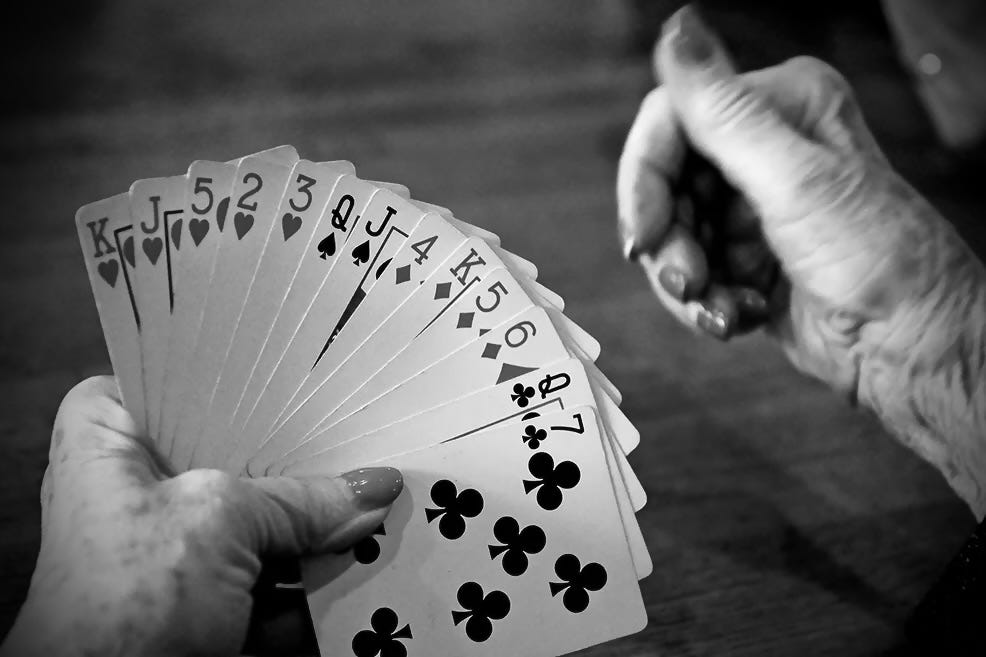
A few years ago, I started to work on a book about the nature of sport. I wanted to explore the boundaries of what we consider to be sport, and what we don’t; to interrogate the gatekeepers. Having already mounted a passionate defence of darts, and argued consistently not just that it clearly was a sport, but perhaps one of its purest examples, I became aware of the erstwhile unsuccesful campaign mounted by the English Bridge Union to have the card game recognised by Sport England as a sport.
I met up with a neurologist who was conducting a study of blood-flow in the brain when it was engaged in playing Bridge. And then I visited a Bridge Club.
I never finished the book, and all that remain of the chapter I had intended to write about Bridge are these few fragments. They are sketches for a bigger picture I never finished.
GREY MATTER
Dr Caroline Small is a neurologist, who’s distinguished fifteen-year career at Imperial College in London has resulted in some significant research into brain function, specifically the endocrinology of hunger, and its effect on neurotransmitters.
We meet in a branch of Costa coffee near her home in Surrey. I am conscious of the fact that I have decided, as it is the first of series of mild days in late February, that I will ride back home on my bike; some forty miles. Therefore, I am listening intently as she describes the effect that hunger can have on the entire physiology.
The brain, she tells me intently as she stirs her coffee, starts to flick a switch, indicating with ever increasing urgency that this depletion of reserves could become an existential crisis. The brain starts to activate transmitters which spread the same thought around every bodily function. Seek food! If this continues, nothing else will matter. It’s a bit like an iPhone going into low power mode, she explains, shutting down latent applications and preventing them from sapping energy. Thus the human body reacts to hunger by reducing the ability to reproduce, and to fight infection. It is verging towards collapse.
Now she is in semi-retirement, the game of Bridge has re-entered her life. Not that it wasn’t there all along. Her husband Cameron is a sometime international player, an obsessive; someone who plays as often and as long as he can, and at a high level too. Her parents (her mother and her step father) were both players. They still are, late in life, into their eighties, and, in her words, ‘sharp as tacks’. They were, in years gone by, in charge of the Brighton and Hove Bridge Club, before they moved to Spain, where for ten years they ran another Bridge Club at Malaga. There are, I was surprised to discover, Bridge clubs for ex-pats (a largely discredited term) throughout Spain. Caroline compares the obvious benefits of their active Bridge lives, with its need for sociability and an active life with her father’s rather lonelier daily fare. The only communication he has, she confides, is ‘with the checkout girl at Tescos’. Then he goes home, alone.
Bridge has the power to train the brain as if it were a muscle. Accessing memory is something of a mystery, since it is still deeply unclear to neurologists exactly WHAT and WHERE the seat of memory lies. What does, however, become apparent under the glare of modern technology is the pathway the brain selects in order to access memory. The concept of neuroplasticity has revolutionized thinking about the brain’s regenerative powers and very structure.
When Caroline started out, the conventional thinking about the brain and its degeneration was that it was irreversible. It was constituted from a finite number of neurons, which, once impaired, implied the decommissioning of that section of the brain. Now it is understood that pathways can be trained around the affected area. At first, she tells me, it’s like riding a bicycle along a path. Then, the more the deviated path is hollowed out, the greater its load-bearing capacity and speed improves. Now it is as if a car is following the route, then a van, then a series of high-speed juggernauts.
In this manner it is broadly accepted that, given the correct procedures and therapies, certain impairments resulting from damage like an aneurism or a stroke, can literally be reversed through training. Bridge is training. The way the game works, the correct execution of the “contracts” between partners on which each hand depends demands a high-functioning and intuitive memory recall, not dissimilar to the playing the extremely irritating boring-car-journey game of ‘I went to the market, and I came back with…’
But Bridge is more than just the game itself. It becomes a way of life, the obligation to one’s partner, to the club, the need to devote hours of one’s life to the game, to meet up with others. People diaries fill up and overflow with appointments and obligations. It is extremely, powerfully socializing, a force for good. And it has tangible, quantifiable, measurable, physiological health benefits. It represdents training for the cells of the body. This is the message behind the research that Caroline is conducting.
The brain is not a wholly separate organ, despite appearances. When late nineteenth century cadavers were injected with blue dye by lugubrious aproned men in wood paneled autopsy chambers, there was a general puzzlement that every tissue in the body would perfuse with the colour, as blood vessels leaked the dye around the body, save, that is, for the brain. It remained grey and floppy and mysterious.
Then on closer inspection, they ascertained that blood vessels in the brain were encased in a non-porous barrier. Expect, of course that it wasn’t that simple. The blood brain barrier (BBB) is occasionally leaky. It can be porous, and allow blood to ebb and flow to a lesser or greater extent. It is connected in deep and mysterious ways with the rest of the human organism. You cannot make the disctinction which was once assumed.
For Caroline, the game of Bridge was all the proof needed that everything was connected.
I left Costa, hopped on the bike, and started to ride. I was hungry.
LOAMPIT AND GOLDHAWK
It’s a curiosity I’ve noticed all my life: Place names live in a symbiosis of meaning with the places they describe. The one feeds the other. After a decade or two, they prop each other up: Westminster, New York, Lewisham.
For example, the main road at the end of our South London street goes by the name of Loampit Vale because once upon a Victorian time, they used to dig for loam there, before the railways, before the cars, before Pret a Manger. Now the workmanlike thoroughfare, which comprises a particularly unlovely stretch of the A20 arterial road, is an archetype of neglected commerce. The faded, turn of the last century housing has been left by successive landlords trying to turn a hopelessly non-aspirational profit into a state of slow decay, with weeds pushing through the stucco, and flimsy doors growing moldy from the bottom up. Its shopfronts feature a grim parade of run-down lettings agencies, unfranchised fried chicken shops whose names are a copyright-flouting invitation to cease and desist.
Loampit Vale. A “vale” is a duller place than a valley, and this one is morosely supported by the sitting gloom of the word “loam”, and the slow horror of the word “pit”. But for what it’s worth, there’s an incandescent South Indian café there which illuminates the whole postcode with radioactively flavoured aubergine bhaji and unreasonably tasty, and irrationally colourful, paneer. It’s home to me and my family.
Goldhawk Road is another such place name. It conjures up imagery that matches its exotic composition. I ride a few miles across town, up the Old Kent Road, through Westminster, and out the other side, before crossing Hyde Park and the legion ambassadorial residences, and then descending towards Shepherds Bush, with its growling ring of traffic, fringing what remains of the green; more of a grey. On its south western corner, by the old Empire theatre, there is Goldhawk Road, leading off towards the messy reality of Acton, with its inviting bustle of middle-eastern eateries, West Indian grocers, Romanian bakeries and Irish pubs.
The eponymous tube station, whose brick-built entrance sits slightly recessed from the road, is flanked by market stalls on either side leading away, down the arches. Jewelry, papaya, baseball caps, patties, Gucci handbags, or their rough equivalents, are all to be had here. There is something flash and edgy, enticing and inspiring about this road. This is London at its most dynamic; far from the real money there is no time to stand still. Livelihoods don’t come looking for you. Indefinably different in flavour, perhaps because of the composition of its immigrant populations, as well as its longer established communities, I have always found this corner of London both thrilling and intimidating. Furthermore, Goldhawk Road is on one a tube line that remains a mystery to most Londoners, myself included, for most of their lives: The Hammersmith and City line. You need to have very specific business, in a very specific part of the city to climb aboard the Hammersmith and City line.
Opposite the tube station, there is a small alleyway, whose entrance is defined by the old and the new of Goldhawk Road. On the one side there is a Sainsbury’s Local, one of the innumerable spores of the supermarket giant that have seeded themselves where family businesses once were. And on the other, there is a tiny old jeweler, Goldhawk’s, whose flaking paintwork and dusty display of sovereigns and chains suggests better times have been and gone. Between these two shops, a concrete path leads onto a courtyard, three sides of which are overlooked by a motley mixture of shop-backs and improvised housing, and one side of which bears aloft the electrified rails of the Hammersmith and City.
At the back of the yard, facing the entrance way, there is a modest and somewhat crumbling porch, whose door hangs deliberately open on the hinge, throwing open a welcome to all. I propped my bike up next to it, and made my way in.
Navigating a path through the arid remains of un-watered hanging plants, past the sign blu-tacked to the wall that urged silence as “play may be in progress” I turned to descend the brown-carpeted stair, and discovered the intense, subterranean world of the Young Chelsea Bridge Club. The day I visited, one blustery lunchtime, they were indeed at play.
BRIDGE OF SIGHS
The first thing I noticed was the quiet. Coming in from the West London street, with the whine of jets approaching Heathrow blown by the rain-flecked wind across the railway lines and over the covered heads of the people walking quickly to avoid the chill, this chasm of calm acted as a sudden rebuff to the senses. In this bunker, the slightest sound left its trace, like an icicle dropping to the ground on a frosty morning.
An orchestral hum from an over-supply of strip lighting provided the background for a range of solo noises to express themselves; the occasional muffled cough, butterfly’s flutterings as decks of cards were flexed, the scratch of pencils, a sigh now and again, and the odd whisper of self-reproach or encouragement. But other than that, only the noise of thought prevailed, that other-worldly realm of strain and exertion, that keeps itself to itself and otherwise leaves no mark on the world. Within seconds of entering the club, it was as if the rest of London, that bit that harried and jostled, haggled and cajoled had slipped out of reality, and only Bridge remained.
Eight tables had been arranged around the room, at which four people sat; two pairs. Each table was divided down the middle by a hardboard screen, set diagonally to separate “North” from “South” and “East” from “West”. The pairs were playing blind, unable to see one another from over the top of the screen, cut off from the silent communication that might otherwise arise. This version of the game was accordingly more serious still than its more sociable cousins.
A women’s tournament was in progress: Day two of a three day long qualifier for the right to represent England at the upcoming international competitions, the pinnacle of which were the world championships. Present in the room was the number one player in the world, Sally Brock, whose presence added importance to the proceedings. Her position at the table emitted pheromones of calculus. She sat bolt upright, phenomenally still, her short-cropped blond hair and green pullover two points of light in the far corner of the room. Her head was bowed, as if in quiet supplication, to the study of the cards fanned out in her light clasp.
Other players showed more signs of fatigue. They had been playing for a few hours already, having started early that Saturday. The previous evening, once they had all assembled, they’d already notched up three hours of play. Ahead of them, they still had a day and a half of play to contend with: a mental, endless ribbon of cards to be noted and committed to memory, stretching ahead in an infinite-seeming timeline into the distance, like a four-suited version the cartoon keyboard from Disney’s Phantasia. Spades, then aces, then hearts, then clubs, all rippling towards the field of vision and out the other side.
Some players had propped their heads up, their temples leaning heavily on clenched fists, elbows on the table like poorly-schooled children. They looked sideways at their cards, almost resentfully. Others twitched unconsciously, settling and re-settling glasses, or shifting their weight in their chairs. Not one player smiled, not once. And if there was one thing they all had in common, it was their unstinting and universal ill-humour, as if they were all dealing with an uncomfortable prognosis from the physician. Bridge, it seemed, was not much fun.
‘Twelve minutes until we break!’ The chief tournament director, Gordon Rainsford, a bald man in his fifties with a carefully ironed scarlet shirt, a name badge and a single, discreet nose-piercing, stood up from his berth, tucked away in the corner of the basement and alerted the players to the need to bring their latest game to a close, and not start another one. ‘Twelve minutes remain.’ His instruction was followed by an almost imperceptible shuffling, as players geared themselves up both mentally and physically for the final push before tea and sandwiches would bring the real world crashing back in.
I looked around me. There were notice boards with lists of recent results, blank sheets for players to sign up for tournaments, photos of recent competition and the odd cutting from newspaper coverage. On the far wall, near a water cooler there hung a series of wooden honours boards, the type you might find in a cricket pavilion or Oxbridge college, featuring the names of some of the most significant winners in recent competition. I gaze at their gold print trying to decipher the oddly named games they referred to, and felt a pang of regret that nowhere in the world, as far as I knew, was there a darkly varnished wooden board hung high on the wall of some communal space that bore my name, with a lovingly painted date alongside it. I was born in 1969. I left school in 1986. I passed my driving test in 1998. Not worth recording.
By now the room was emptying, fast. A very neatly dressed lady was folding her glasses and putting them no the table, rubbing her eyes. Her playing partner, some years her senior, was stiffly pulling on a long, elegant winter coat, about to make the trip outside. They were negotiating about sandwiches.
‘So what would you like?’
‘Oh, I don’t mind.’
‘Tuna?’
‘I’m not bothered.’
DEALING IN DEATH
Carole Kelly, twice an England international player, pushed off into the chill of the West London afternoon, leaving her playing partner of some twenty years, Sandy Davies to sit quietly at her seat, trying to re-gather her strength for the coming afternoon session. They were trailing in the match, but not irretrievably. So there was much still to play for.
‘I’m terribly competitive,’ Sandy tells me, when I draw up a seat alongside her. Though she is reluctant at first to sacrifice her free half hour, and slightly wary of my interest, she quickly warms to subject of the game she loves. ‘It’s absolutely wonderful to win. But quite awful to lose.’
She is a very alert, punctiliously well turned out lady in her late sixties, whose eyes shine with a kind of beady intelligence you would never wish turned to your disadvantage. When she talks, a slight smile plays across her sharp features, and when she listens, she looks intently at whoever’s talking, her head cocked almost imperceptibly to one side, like a garden bird on a fence, waiting motionless before striking.
Sandy has been playing Bridge, one way or another, for half a century, beginning as a teenager. Without the slightest self-pity, she talks to me about the quiet, tense restraint of her upbringing in the 1950s, the only child of a middle class family from Grimsby. Her parents, who divorced when Sandy was in her teens, had reached a state of total disdain for one another. Neither could look the other in the eye, nor entertain the prospect of starting a conversation. The only communal activity of any description they could countenance was the playing, silently of Bridge. And young Sandy’s only option, to avoid a home life of total isolation, was to join them.
‘It was the only thing that stopped them from killing each other, I think,’ chuckles Sandy, laughing off those distant memories of parental dysfunction that led, by a circuitous route, to a high-level Bridge career. She glances at her watch, anxiously aware that the minutes of her half hour break are slipping away and that Carole has yet to return with her sandwich.
‘Of course,’ she continues, ‘people have been killed over a game of Bridge.’ Again, there’s that light in her eyes, as if she finds the whole thing a bit of a hoot, as if her she had lived her life like the guest at an Agatha Christie-themed murder mystery weekend.
She’s quite correct, of course. Bridge is a game which developed under mysteriously organic circumstances at the end of the 19th Century, possibly in Russia, possibly in the Crimean, when British soldiers posted in Istanbul idled away the hours in Turkish coffee houses on the banks of the Bosphorus trying to remember which cards had already been played, before dying of dysentery. But though its origins are shrouded in mystery, Bridge’s reputation is firmly established as an arbiter of petit-bourgeois conservatism; a game for salons and drawing rooms, in which the higher virtues of talking only in perfectly turned witticisms, or not at all, were prized above the coarser nature of human interaction.
And yet, occasional shards of evidence splinter the genteel veneer of this most conservative of card games, suggesting there is a hidden reserve of pent-up emotion that Bridge either fosters, or struggles to contain. And occasionally it breaks out in unexpected ways.
‘You know about the Boston murder, I take it?’
I didn’t know about the Boston murder. Sandy told me instead.
One Sunday, tucked away in an upstairs room at a well-appointed condominium building in downtown Kansas City, Missouri, two neighbouring couples were engrossed in a game of Bridge that had been going on for the best part of the day. The year was 1929, and outside, the city was flicking electric lights on across its expanse of increasingly high-rise brick towers. Evening was gathering in along the streets of this dynamic, changing metropolis, in which John Bennett, a handsome young businessman had started to amass a fortune in the perfume trade. He, and his wife Myrtle were entertaining their friends the Hofmans.
That evening they dined together, and then started to play Bridge. It was after midnight when it became apparent that the Hofmans were going to win, and the Bennetts started to snap at each other. In the very final hand of the evening, John Bennett failed to make his four spade contract (don’t worry, I don’t know either) and lost the game. His wife, furious with him, chastised him in front of the Hofmans, calling him a ‘bum player’. John slapped her in front of the guests, declared that he was going to spend the night in a motel and started to pack. Myrtle then went to the bedroom, took out his revolver, walked back into the living room, pushed Charles Hofman to one side and shot her husband in the back. To this day the case is known as The Bridge Murder Case.
It is a game of surprising passions.
I thanked Sandy, wished her all the best for the rest of the game and then left Goldhawk Road.
As I headed home I thought about how much of the world is still beyond my comprehension. And good that it is so. You never know what is going on behind the closed doors of any house, any time, on any street.
Brilliant as always, Ned, I guess the difference between competitive bridge and social bridge is a bit like going out for a bike ride on a sunny day and competing in the TdF!
I’ve never had the faintest interest in Bridge, but I enjoyed your description of the club, and especially your writing. Châpeau, as we say in our other field of interest. 👌